What Does APR Tell You About a Loan?

September 16, 2026

When comparing loans, the monthly payment often gets the most attention. It is easy to understand why: borrowers need to know whether the payment fits into the budget.


But the monthly payment does not tell the whole story.


Another number to review is the annual percentage rate, or APR. APR can help borrowers compare the cost of different loans by expressing certain borrowing costs as a yearly percentage. Understanding what that number represents can make it easier to evaluate whether one loan is more expensive than another.

Infographic explaining APR formula with bold blue title and icons for fees, principal, and number of payments.

APR Is More Than the Interest Rate

The interest rate is the percentage charged for borrowing the principal.


APR is broader.


Depending on the loan, APR may incorporate the interest rate along with certain fees or finance charges. That makes it useful for comparing borrowing costs when two loans have different structures.


For example, one loan might advertise a lower interest rate but include higher fees. Another might have a slightly higher interest rate with fewer additional costs.


Looking at APR can provide a more complete basis for comparison than looking at the interest rate alone.
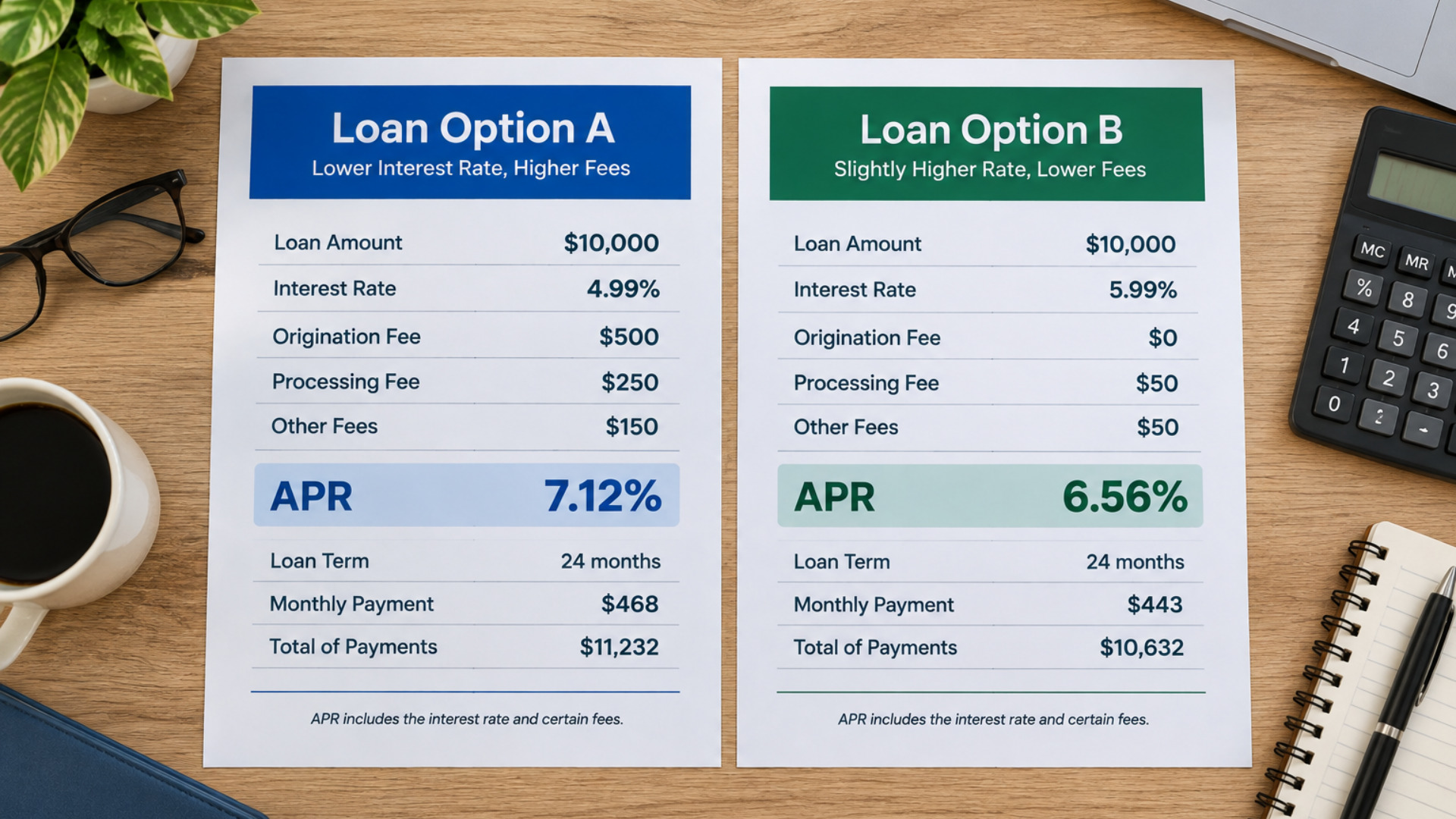
Two loan offer flyers, Loan Option A and B, on a desk with a calculator, coffee, and notebook

A Lower APR Usually Means Lower Borrowing Costs

When two similar loans have the same term and amount, the one with the lower APR will generally have the lower overall borrowing cost.


However, comparisons work best when the loans themselves are similar.


A six-month loan and a two-year loan, for example, may have very different payment structures and total costs even if the APRs appear close.


That is why APR should be reviewed alongside the loan term, payment amount, total of payments, and other disclosures.
Close-up of a financial form with a bright orange pen highlighting loan and maintenance log details.

APR Does Not Tell You the Monthly Payment

APR is not a monthly payment percentage.


It is an annualized measure of borrowing cost.


Your actual payment depends on factors such as:

  • Amount borrowed
  • Interest rate
  • Loan term
  • Payment frequency
  • Applicable fees
  • Repayment structure


A loan with a lower monthly payment may still cost more overall if repayment is stretched over a longer period.


This is why choosing a loan based only on the smallest payment can be misleading.

Hands writing on a clipboard with a blue pen at a table

Loan Term Changes the Bigger Picture

Loan length has a major influence on affordability and total cost.


A longer term can reduce the amount due each month, which may make the payment easier to fit into a budget. However, extending repayment may also mean paying interest for a longer period.


A shorter term can produce a higher payment but may reduce the amount paid over time.


Neither option is automatically better.


The important question is whether the payment is manageable without creating financial strain and whether the overall cost is reasonable for the need being financed.

Two people collaborating at a desk with a laptop, notebook, calculator, and papers.

Compare the Total Amount Repaid

APR is useful, but it should not be the only number you review.


Loan disclosures may also show the total amount you will repay if payments are made according to schedule.


That figure can make borrowing costs easier to visualize.


If you borrow $2,000, for example, seeing exactly how much you are expected to repay over the life of the loan may be more meaningful than looking at a percentage by itself.


Review both figures before agreeing to a loan.

Loan agreement document on a desk with a pen, calculator, and glasses nearby.

Fees Still Deserve Attention

Even when certain fees are reflected in APR, borrowers should still understand what charges apply.


Read the agreement carefully and look for origination fees, late-payment charges, returned-payment fees, or other costs that may affect the loan.


You should also understand whether early repayment changes the cost and whether any prepayment restrictions or charges apply.


The goal is to know what you are agreeing to before the money is borrowed, not after the first bill arrives.

Three people discussing documents around a laptop at a conference table in a bright office

APR Makes Comparison Easier, Not Automatic

APR is best used as a comparison tool.


If several lenders are offering similar loan products, APR can help highlight differences in borrowing costs.


But the lowest APR does not automatically mean the loan fits your situation.


A loan can still be unaffordable if the payment is too large for your budget. Likewise, borrowing more than necessary can create problems even when the APR appears competitive.


Affordability should always come before approval.

Two people reviewing a document and signing paperwork at a desk with a pen and cash nearby

Review the Full Loan Before You Borrow

APR helps answer an important question: how expensive is this loan relative to the amount being borrowed?


It should be reviewed alongside the monthly payment, term, fees, total repayment amount, and your existing financial obligations.


Portside Finance encourages borrowers to understand the full cost of a short-term installment loan before making a decision. If you are considering borrowing, review the APR and repayment schedule carefully, borrow only what you reasonably need, and make sure the payment leaves enough room in your budget for essential expenses and unexpected costs.

September 8, 2026
A credit score can move up or down even when every bill has been paid on time. That can be confusing, especially for someone who assumes payment history is the only factor affecting the number.  Payment history is very important, but credit scoring models also consider other information in your credit report. Changes in balances, account activity, new applications, credit limits, and the age of your accounts can all influence your score. Understanding those factors can make credit changes feel less mysterious and help you focus on habits that matter over time.
September 2, 2026
When you have several debts at the same time, deciding where to focus can feel overwhelming. Credit cards, installment loans, medical balances, auto loans, and other obligations may all have different interest rates, minimum payments, and payoff timelines.  There is no single payoff strategy that is right for everyone. The best approach depends on your budget , interest costs, motivation, and need for financial flexibility. What matters most is choosing a method you can maintain consistently.
August 25, 2026
Your credit score is influenced by several factors, and one of the most important is credit utilization. Even people who consistently pay their bills on time can see their credit scores move up or down depending on how much revolving credit they are using.  Understanding credit utilization can make it easier to manage credit cards strategically, avoid unnecessary score fluctuations, and build healthier long-term financial habits.
August 18, 2026
A credit report is a detailed record of how you have managed certain types of credit and debt. Lenders, landlords, insurers, and other organizations may use information from your credit report when making decisions about applications, rates, deposits, or other financial matters.  Understanding what appears on your credit report can make it easier to monitor your financial history, identify errors, and build stronger credit habits. Portside Finance encourages consumers to review their credit information regularly and understand how everyday borrowing and payment decisions may affect their financial profile.
August 11, 2026
Even a carefully planned budget can get off track. An unexpected car repair, a higher utility bill, a family obligation, or simply a month with more discretionary spending than usual can push expenses beyond the amount originally planned. Going over budget does not mean the entire financial plan has failed. What matters most is how quickly the situation is reviewed and adjusted.  Recovering from an over-budget month starts with understanding what happened, identifying which expenses can be changed, and creating a practical plan for the weeks ahead. Portside Finance encourages consumers to approach short-term financial setbacks with organization, realistic expectations, and responsible decision-making rather than panic.
August 4, 2026
Strong money management is not about earning a certain income or having extensive financial experience. It is about developing habits that help you make informed decisions, prepare for unexpected expenses, and work toward your financial goals with confidence. Whether you are just beginning your financial journey or looking to strengthen your current routine, improving your money management skills can provide long-term benefits.  Every financial situation is unique, but a few practical strategies can help almost anyone build a stronger financial foundation. Portside Finance encourages responsible financial planning and believes that informed decisions today can support greater financial stability tomorrow.
July 28, 2026
Unexpected expenses are a part of life. A vehicle may require an expensive repair, a home appliance may stop working without warning, or an unforeseen medical expense could suddenly affect your monthly budget. While it is impossible to predict when these situations will arise, preparing for them financially can help reduce stress and make it easier to move forward with confidence.  One of the most effective ways to prepare for life’s surprises is by building an emergency fund . Even modest savings set aside over time can provide valuable financial flexibility when unexpected costs occur.
July 21, 2026
Not all borrowing works the same way. Whether you are covering an unexpected expense or managing a temporary financial gap, understanding the differences between revolving credit and a personal loan can help you make more informed financial decisions.  While every person’s financial situation is unique, revolving credit can become difficult to manage if balances continue to grow over time. In some situations, a small personal installment loan with predictable payments may provide a more structured approach to borrowing.
July 14, 2026
Your credit score is one of the most important numbers in your financial life. It can affect your ability to qualify for loans, rent a home, secure favorable interest rates, and even influence certain employment or insurance decisions. While many people know that paying bills on time is important, fewer understand the full range of factors that contribute to a healthy credit profile.  Learning how credit scores work can help you make informed financial decisions and develop habits that support long-term financial wellness.
July 7, 2026
No matter how carefully you plan, life has a way of introducing unexpected expenses. A vehicle may need repairs, a household appliance may stop working, or an unplanned medical bill may arrive at an inconvenient time. While it is impossible to predict every financial challenge, it is possible to build a budget that is flexible enough to handle many of life’s surprises.  A well-designed budget is not meant to be rigid. Instead, it should provide structure while allowing room to adjust as circumstances change. The more adaptable your budget becomes, the better prepared you may be to navigate unexpected expenses without disrupting your long-term financial goals.
More Posts